
(WKYT) – As the network of automatic license plate readers grows alongside controversy over the technology, Kentucky lawmakers are learning more about how they’re used and what policies govern them.
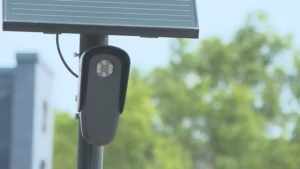
Kentucky’s Interim Joint Committee on Judiciary heard from a Flock Safety representative and other stakeholders on Thursday after many lawmakers said they’ve heard concerns from constituents. According to Flock Safety, the private company’s technology is used by law enforcement agencies in more than 6,000 communities nationwide, including many in Kentucky. Lexington has 125 of the devices.
Law enforcement support
Elizabethtown Police Chief Jeremy Thompson attended the meeting to testify on how the technology has enhanced his department. Chief Thompson told lawmakers that license plate readers are not new, but access to them has expanded beyond a single police car or officer.
“In nearly 30 years of law enforcement, this is the best piece of technology to assist law enforcement in real-time information to help solve crime,” Thompson said.
Flock Safety Director of Governmental Affairs Kevin Kane also addressed lawmakers. He explained what the technology does and does not do. According to Kane, an average of 27 people per day are reunited with their families nationwide due to Flock’s automatic license plate readers.
Privacy concerns
The technology remains controversial. People are worried about what data the cameras collect and how it’s stored. Kane addressed some of those concerns directly and said that Flock ALPR data captures images of license plates for legitimate law enforcement purposes. He said that a majority of the pictures taken are never accessed and are always deleted after a set retention period.
The American Civil Liberties Union remains opposed to the technology. ACLU Senior Policy Counsel Jina John said Flock cameras raise Fourth Amendment concerns, pointing to the risk of combining the technology with other surveillance tools.
“The real risks around mass surveillance aren’t just the use of a single ALPR tool or a single surveillance camera; it’s the proliferation of ALPRs and the combination with other technology,” John said.
Kentucky ACLU Advocacy Director Kate Miller said the organization wants to see further revisions to state policy surrounding the technology, including a possible pause on new government contracts with Flock.
“It might be appropriate to take a pause on the use of government-issued, administered, or contracts with Flock cameras. Most importantly, we really want to be thoughtful about the data and the retention of the data,” Miller said.
Lawmakers weigh in
Lawmakers passed House Bill 58 last session, which limits who can use automatic license plate readers and requires agencies to publish a public audit every 90 days to prevent misuse.
Several lawmakers said they’ve heard concerns from constituents about Flock cameras in their communities. While many understand the benefits for law enforcement, almost all legislators agreed further policy and regulation may be needed to protect privacy.
“The bigger question is that our constitutional system limits government power precisely because we don’t know who will possess the power tomorrow,” Rep. Jennifer Decker (R-District 58) said.
“I would just ask that we don’t condemn the tool; we condemn the improper use of it,” Sen. Danny Carroll (R-District 2) said.
“We should not be holding you responsible for regulating yourself; it’s our job as policymakers to give you regulations and policies to abide by if you’re operating in our Commonwealth,” Rep. Nima Kulkarni (D-District 40) said.
Thompson, who also serves on the Kentucky Association of Chiefs of Police executive board, told lawmakers he would work to hold police officers accountable if they misuse Flock data.