
(WKYT) – As national conversations grow around the use of Flock cameras, police agencies in Central Kentucky say the automated license plate readers are helping them solve crimes faster and bring justice to victims.
Central Kentucky police departments started installing Flock cameras in 2022. The cameras photograph license plates as cars drive past and compare them with the National Crime Information Center database, run by the FBI. If a plate is linked to a crime, the department is immediately alerted, but staff verifies each hit before dispatching an officer.
Lexington Police Department Commander Matthew Greathouse said the technology is about efficiency.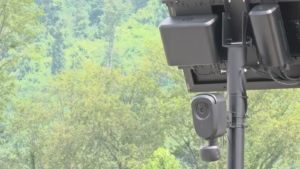
“From the time a crime occurs to the time we are ready to actually stop somebody or make an arrest, we want to compress that time down,” Greathouse said.
What the cameras can — and cannot — do
The cameras only capture a license plate number and the reason for flagging. They cannot detect speed, identify the driver, or see inside a vehicle, and no other personal data is collected.
Greathouse said the technology allows officers to focus on the right people.
“We want to be able to put our officers where they need to be, and to be focused on the exact people that are involved and not stop every red four-door sedan you see driving down the road thinking it could be involved in a crime or is stolen; we want to find the exact person and leave everybody else out of it,” Greathouse said.
According to the Lexington Police Department’s transparency page, the cameras have helped find 32 missing people, seize 166 firearms and recover more than $5.5 million in stolen property since 2022.
Winchester success story
Winchester is no exception. On Saturday, Winchester Police Chief Travis Thompson said his department received a Flock hit on a license plate tied to a sex trafficking suspect from Virginia. He said that Virginia police had entered the plate into the Flock system, and when the suspect drove past a camera in downtown Winchester, it generated a hit.
Thompson said officers verified the open investigation and arrested the suspect at a gas station across from the police department. The suspect was extradited back to Virginia.
“Many, many crimes that are committed, a vehicle is associated,” Thompson said.
Thompson said misconceptions spreading on social media are frustrating.
“We can’t go and just put handcuffs on somebody because they were on a Flock camera; we just use that information to build our case and to develop the probable cause that we need to make an arrest on a crime,” Thompson said.
Thompson also said cameras in his department are being vandalized more frequently amid the controversy. Each camera costs about $3,000.
“It is a felony, and if we catch somebody doing it, then we’re going to prosecute that,” Thompson said.
Oversight and data retention
Legislation passed last session established limitations on automated license plate readers, including a public audit every 90 days to prevent misuse. Winchester adopted that policy last month. Lexington has conducted audits since the cameras were installed, with no issues reported.
The legislation also states that license plate data must be deleted after 90 days. Lexington police delete captured images after 60 days, but Greathouse said that window has proven critical. He recalled a homicide case where investigators found a vehicle association 59 days after it had been captured by a Flock camera, leading them to a suspect they previously had no information on.
The Lexington Police Department website includes the public policy regarding these cameras, their locations, and an example of what comes through the Flock system.